My research is focused on the architecture and evolution of the accretionary wedges, including the megathrust fault and splay faults branching from it, and their connection to megathrust earthquakes. To address these problems holistically, I combine marine active-source seismology offshore and field geology onshore to understand how seismogenic processes operate in subduction zones.
The Alaska subduction zone
In my postdoctoral work, I am using bathymetry and seismic reflection data to analyze the structure and activity of splay faults in the 1964 Mw9.2 rupture area.
Fault activity at the Cascadia subduction zone
I use seismic reflection data to understand active splay faulting and consider the evidence for coseismic slip on these faults. I pair high-resolution sparker with crustal-scale multi-channel seismic reflection data to identify the faults that exhibit evidence of activity in the very late Quaternary—and in some cases Holocene—but also link to the megathrust at depth, thus having the potential to slip during megathrust events. My findings in Ledeczi et al. (2024) support the hypothesis that many splay faults are potential candidates for hosting coseismic slip, and that Cascadia will likely experience distributed shallow rupture on multiple splay faults located within ~30 km of the deformation front in a future megathrust event.
Related work:
- Ledeczi, A.M., Lucas, M.C., Tobin, H., Watt, J., and Miller, N. (2024). Late Quaternary surface displacements on accretionary wedge splay faults in the Cascadia Subduction Zone: Implications for megathrust rupture. Seismica, 2(4). DOI: 10.26443/seismica.v2i4.1158
- Lucas, M.C., Ledeczi, A.M., Tobin H.J., Carbotte, S.M., Watt, J.T., Han, S., Boston, B., and Jiang, D. (2025). No evidence for an active margin-spanning megasplay fault at the Cascadia Subduction Zone. Seismica, 2(4). DOI: 10.26443/seismica.v2i4.1477
- Biemiller, J., Gabriel, A.-A., Staisch, L., Ulrich, U., Dunham, A., Wirth, E., Watt, J., Lucas, M.C., and Ledeczi, A.M. (2025) Structural controls on splay fault rupture dynamics during Cascadia megathrust earthquakes AGU Advances. DOI: 10.1029/2025AV001812
- Ledeczi, A.M., Tobin, H.J., Miller, N.C., Carbotte, S.M., Han, S., and Boston, B. Evidence for a sediment-hosted plate boundary fault at the Cascadia subduction zone. (In review at Geochemistry, Geophysics, Geosystems).
Fault databases and community resources
I’ve worked with collaborators to turn my identified faults into 2D and 3D geometries usable for the community. I work with the Cascadia Earthquake Science Center, including on the Community Fault Model Working Group.
Related work:
- Lucas, M.C., Ledeczi, A.M., Dunham, A., and Watt, J.T., 2026, Simplified frontal thrust splay fault geometries at the Cascadia Subduction Zone mapped using multi-channel seismic (MCS) reflection data, U.S. Geological Survey data release, DOI:10.5066/P138BZRA
- Watt, J.T, Ledeczi, A.M., Lucas, M.C., and Tobin, H.J. Quaternary faults offshore the U.S. Cascadia subduction zone. USGS Data Release. DOI: 10.5066/P14HJMM9 (In review with USGS).
- Fildes, R.A., Amos, C., Roland, E.C., Streig, A.R., Bennett, S.E.K., Hatem, A., Ledeczi, A.M., Meigs, A.J., Styron, R., Tobin, H.J. A 2-D and 3-D Community Fault Model for the Cascadia Subduction Zone. CRESCENT CFM Version 1.0. (In review).
- Melgar, D., Thomas, A. M. , Sahakian, V., Share, P.-E. , Meigs, A. , Tobin, H., Staisch, L., Melbourne, T., Elizabeth, J. , Ajala, R., et al. (2026). The Cascadia Region Earthquake Science Center (CRESCENT): Advancing Understanding of Cascadia’s Earthquake Hazards. Seismological Research Letters. DOI: 10.1785/0220250318
- Sahakian, V. J., Meigs, A.J., Clifford, A., Fasola, S., Melgar, D., Thomas, A. M., Share, P.-E., Tobin, H., Melbourne, T., Elizabeth, J., et al. (2026). The Cascadia Region Earthquake Science Center (CRESCENT): Regional Science in a Resilience Context. Seismological Research Letters. DOI: 10.1785/0220250423
The Olympic Subduction Complex, Olympic National Park
While geophysical tools have allowed us to probe active accretionary wedges, direct evidence of the conditions that promote coseismic slip can only be found by examining the plate boundary itself, such as through exhumed subduction terranes. In this work, I documented a previously undescribed exhumed seismogenic paleomegathrust interface in the Olympic Mountains, WA—the first such example from the modern Cascadia subduction zone. Until this work, no geological investigations have been conducted in the Olympic Core west of Mt. Olympus since the 1970s.
Related work:
- Ledeczi, A.M., Tobin, H.J., Chen, T., and Mulcahy, S., and Condit, C. (2025). Structure and properties of the Cascadia plate interface: Evidence from a newly described exhumed paleomegathrust in the Olympic Subduction Complex. GSA Bulletin. DOI: 10.1130/B38335.1
- Ledeczi, A.M., Tobin, H.J., Condit, C.B., Chen, T-W., Lindquist, P.C., García-Lasanta, C., Housen, B., and Mulcahy, S.R. (2026). Off-fault mélange formation accommodates only a small fraction of strain in the subduction seismogenic zone. (2026) Earth and Planetary Science Letters. DOI: 10.1016/j.epsl.2026.120341
Other projects
-
Ledeczi, A.M., Ekström, G., & Taylor, B. (2025). Earthquake relocations illuminate tectonics along the Bismarck Sea Seismic Lineation, Papua New Guinea. Seismica, 4(2). DOI: 10.26443/seismica.v4i2.2041
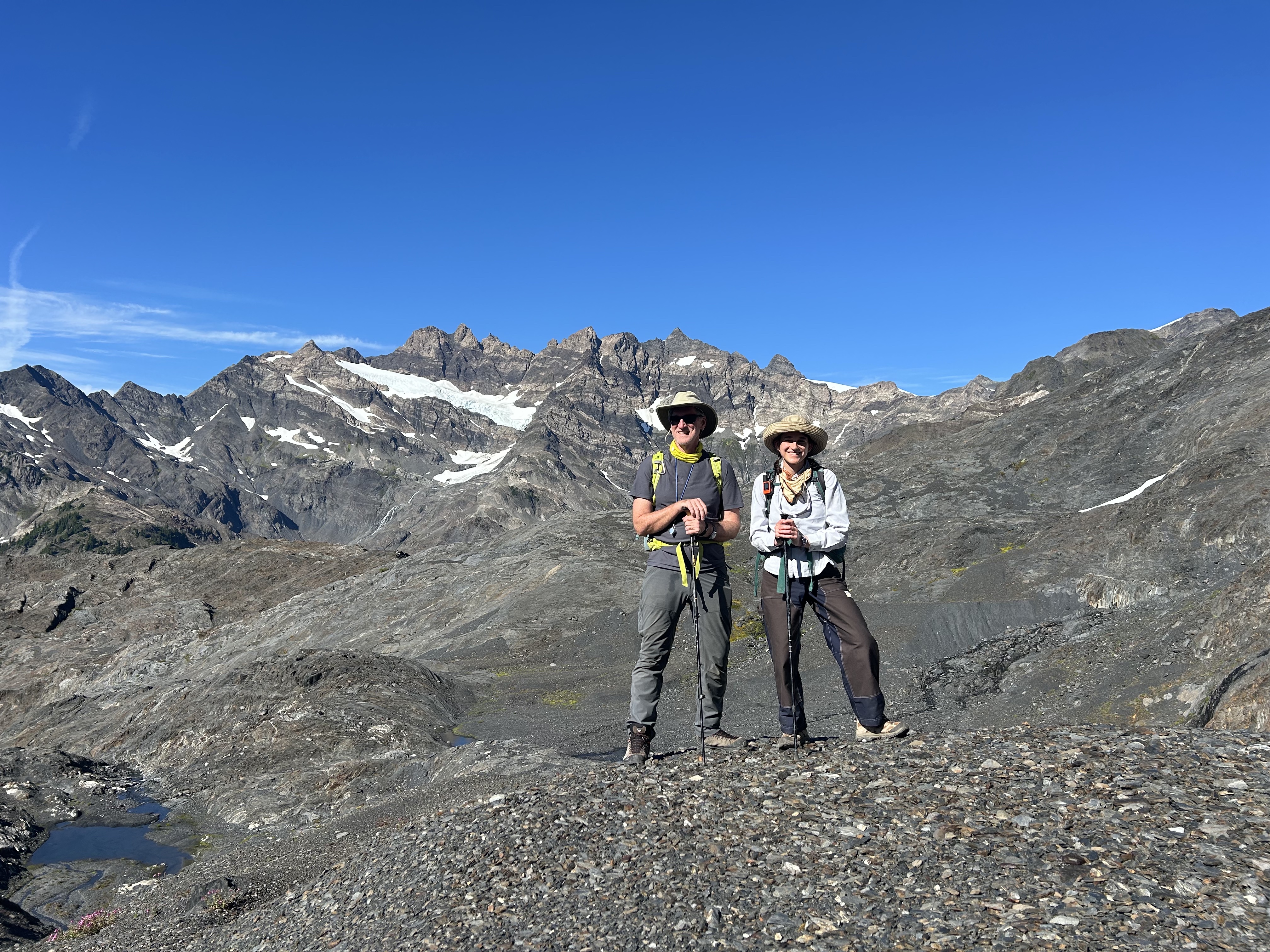
Harold Tobin and Anna Ledeczi with the south face of Mt. Tom and Mt. Olympus.